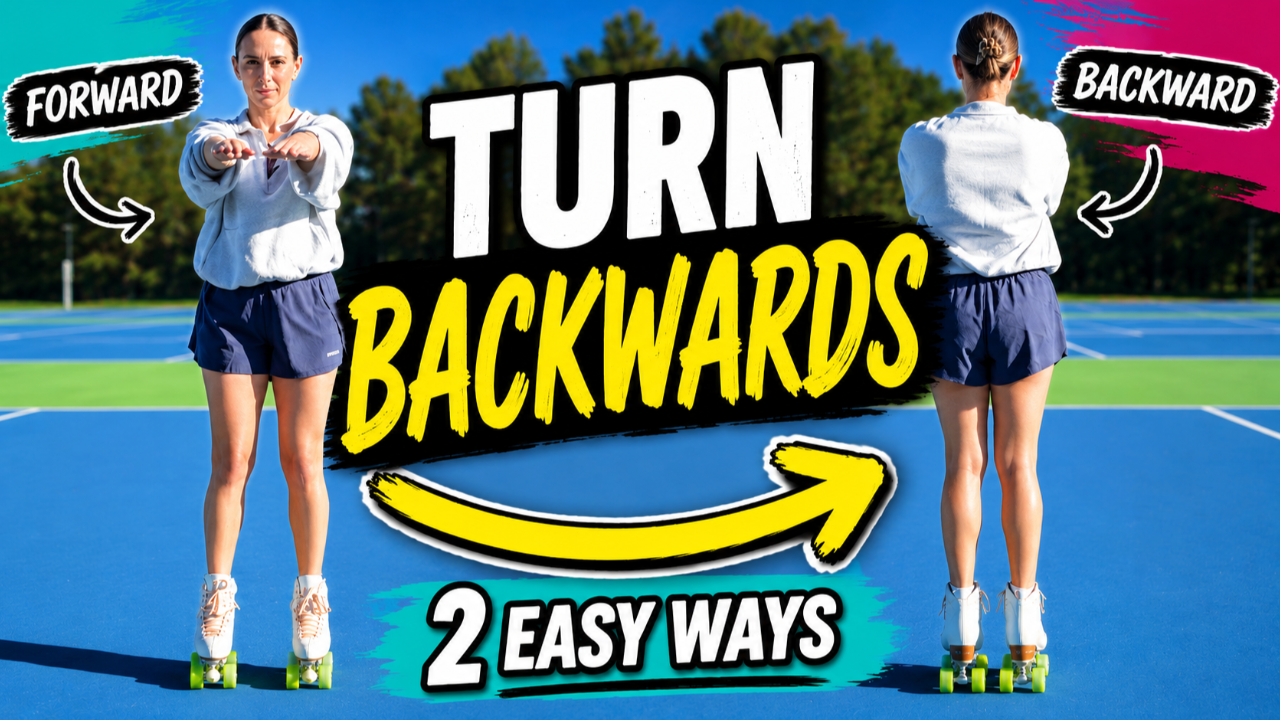
How to Turn Around on Roller Skates (2 Easy Beginner Methods)
Jul 06, 2026
Have you ever tried to turn around on roller skates and somehow ended up twisted sideways?
Or maybe you've watched other skaters do it effortlessly and thought:
"Why does that look so easy for them?"
If so, you're definitely not alone.
Turning around is one of those skills that opens up so many new possibilities. It helps you start learning backwards skating, recover when you accidentally end up facing the wrong direction, and simply feel more confident on your skates.
But here's something I see all the time when teaching beginner skaters...
Most people think turning around is a footwork problem.
In reality?
It's usually a confidence problem.
After teaching hundreds of beginner skaters, I've noticed people rarely get stuck because their feet can't do the movement.
They get stuck because they stop trusting it halfway through.
They start the turn, the shoulders stop rotating, the weight stays back...
And suddenly they're standing sideways wondering what happened.
If that's you, don't worry. I've seen it hundreds of times.
The Secret Most Beginners Miss
When people learn transitions, they often focus on their feet first.
But your feet are actually one of the last things that should happen.
Think about it this way.
Imagine somebody calls your name from behind you.
You wouldn't twist your foot first.
You'd naturally:
-
Look behind you
-
Turn your shoulders
-
Let your hips follow
-
Then allow your feet to move underneath you
That's exactly how a good transition works on roller skates.
The head leads. The body follows. The feet finish the movement.
Once you understand that, turning around starts to feel a lot more natural.
Method 1: The Open Book Transition
The Open Book Transition is probably the most common way skaters learn to turn around.
And when it clicks, it feels really smooth.
The movement starts by looking where you want to go, opening your shoulders in that direction and allowing your hips to follow before stepping around.
What I often see beginners do instead is focus entirely on the step.
They try to force the foot around first.
Then everything feels awkward.
If you're struggling with this transition, stop worrying about the feet for a moment.
Instead ask yourself:
Am I actually looking where I want to go?
Because most of the time that's where the problem starts.
Make It Easier
One of my favourite ways to practise this is actually off skates.
Try it:
-
On carpet
-
On grass
-
On a yoga mat
This takes away the fear of rolling and allows you to focus purely on learning the movement pattern.
Remember:
You don't have to master the skill immediately.
You're simply teaching your body what the movement feels like.
Start With A Quarter Turn
Another mistake I see beginners make is trying to jump straight into a full 180-degree transition.
Instead, start smaller.
Practice turning 90 degrees first.
Focus on:
-
Looking first
-
Opening the shoulders
-
Rotating the hips
-
Stepping into the new direction
Once that feels comfortable, gradually build up to the full turn.
You'll often find the 180 becomes much easier because you've already taught your body the movement.
Why You Keep Getting Stuck Halfway
If you constantly get stuck in the middle of the turn, check these three things:
1. Are you looking where you want to go?
2. Have your shoulders fully opened?
3. Have you transferred your weight onto the stepping foot?
Most of the time, one of those three things is missing.
And when it is, your hips stop rotating and your feet get trapped halfway through the movement.
The solution usually isn't more effort.
It's going back and fixing the setup.
Method 2: The Heel-Toe Pivot
Now, if the Open Book Transition feels awkward or intimidating, don't panic.
There is another option.
In fact, many of my adult beginner skaters prefer this one.
The Heel-Toe Pivot allows your skates to stay connected to the floor while you're turning.
For many people, that feels far less scary than stepping onto one foot.
The upper body stays exactly the same.
You're still:
-
Looking where you want to go
-
Opening your shoulders
-
Rotating your hips
The difference is that instead of stepping around, you're pivoting.
The front skate pivots on the heel.
The back skate pivots on the toe.
And before you know it, you're facing backwards.
Why I Like This Version For Beginners
You may have seen skaters use a heel-heel pivot.
That's completely fine.
But I often teach beginners to pivot the back skate on the toe wheel because it tends to feel more stable.
I've found newer skaters are less likely to accidentally slip backwards when they keep that back skate on the toe wheels.
And when you're building confidence, those little wins matter.
Which One Should You Learn?
The answer is simple.
Try both.
Some skaters instantly connect with the Open Book Transition.
Others feel much more comfortable with the Heel-Toe Pivot.
Neither is right.
Neither is wrong.
The goal isn't to do the "correct" transition.
The goal is to find the one that helps you turn around confidently and safely.
Final Thoughts
If you're struggling to turn around on roller skates, don't assume you're doing something wrong.
Most beginners go through this stage.
Keep reminding yourself:
Look first.
Open the shoulders.
Let the hips follow.
The feet usually sort themselves out after that.
And with a little practice, turning around becomes one of those skills that suddenly feels far easier than it did on day one.
Want to see both methods demonstrated step-by-step?
I've put together a full video tutorial where I break down exactly how I teach these transitions to my beginner students.
👉 Watch the full tutorial on YouTube
You'll be able to see the body position, weight transfer and common mistakes in action, which often makes learning the movement much easier.
Still Getting Stuck With Roller Skating?
One thing I've noticed after teaching hundreds of beginner skaters is that most people don't need more courage.
They need a clear plan.
That's exactly why I created my FREE 5-Day Learn to Roller Skate Series.
I'll guide you through the key beginner skills step-by-step so you know what to practice and can start building confidence on your skates.
Click the link below and I'll send Lesson 1 straight to your inbox!
Want more beginner skating tips?
Join for new videos, articles and skating encouragement 💛
We hate SPAM. We will never sell your information, for any reason.